

“The soul never thinks without a mental image.” Aristotle p. 177
From his earliest days in Nigeria, Omeh saw the world not in words but in feelings and color. Labeled a failure in school, he found language through drawing — the one place he could exist fully. What began as escape became revelation: art as translation, as healing. Over time, he learned that the stories in his work could awaken others too. Every canvas is now a séance — a bridge between pain and beauty, silence and expression. Omeh paints not to be seen, but to help others see themselves.
Chinemerem Eme Omeh
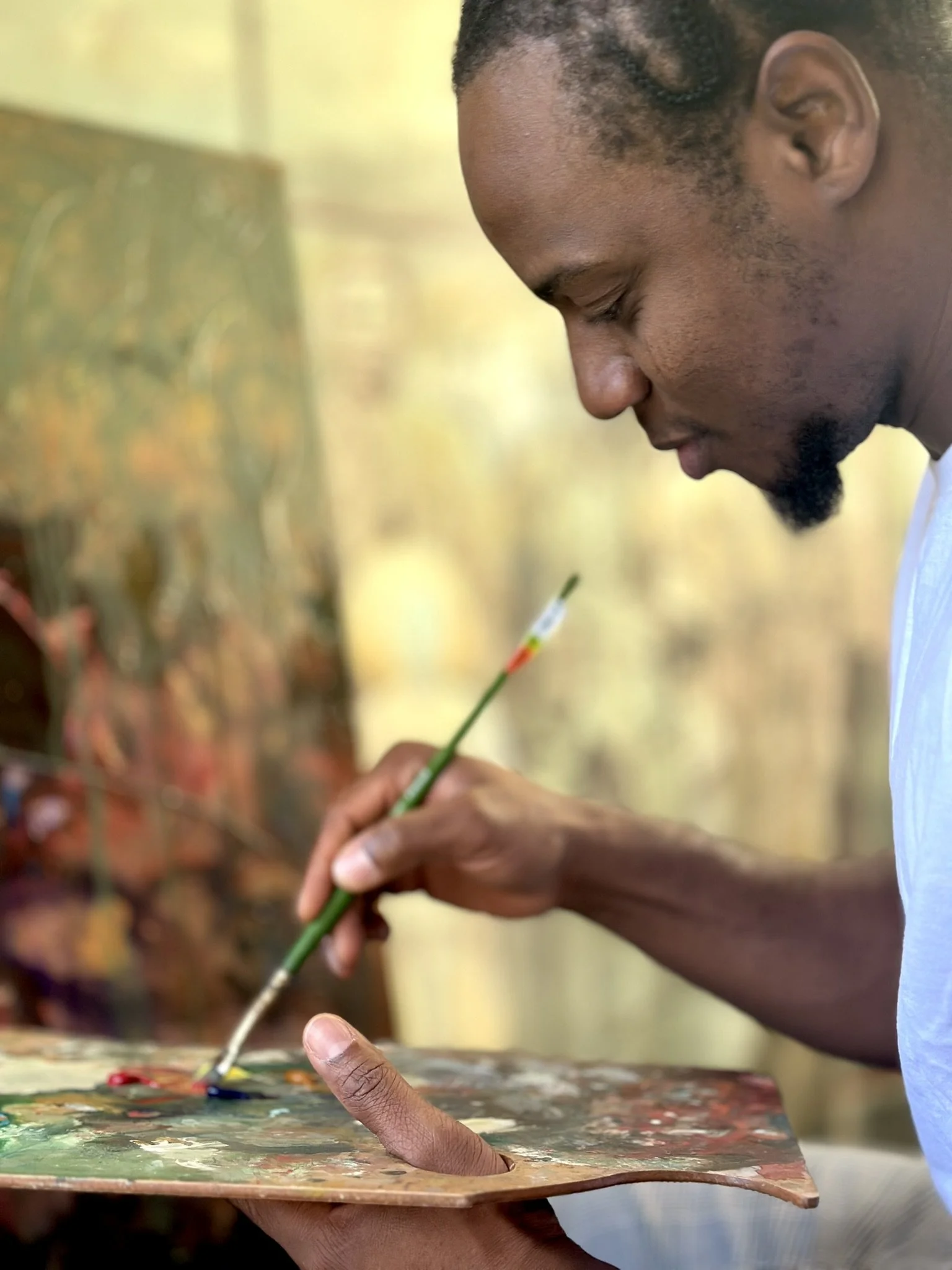
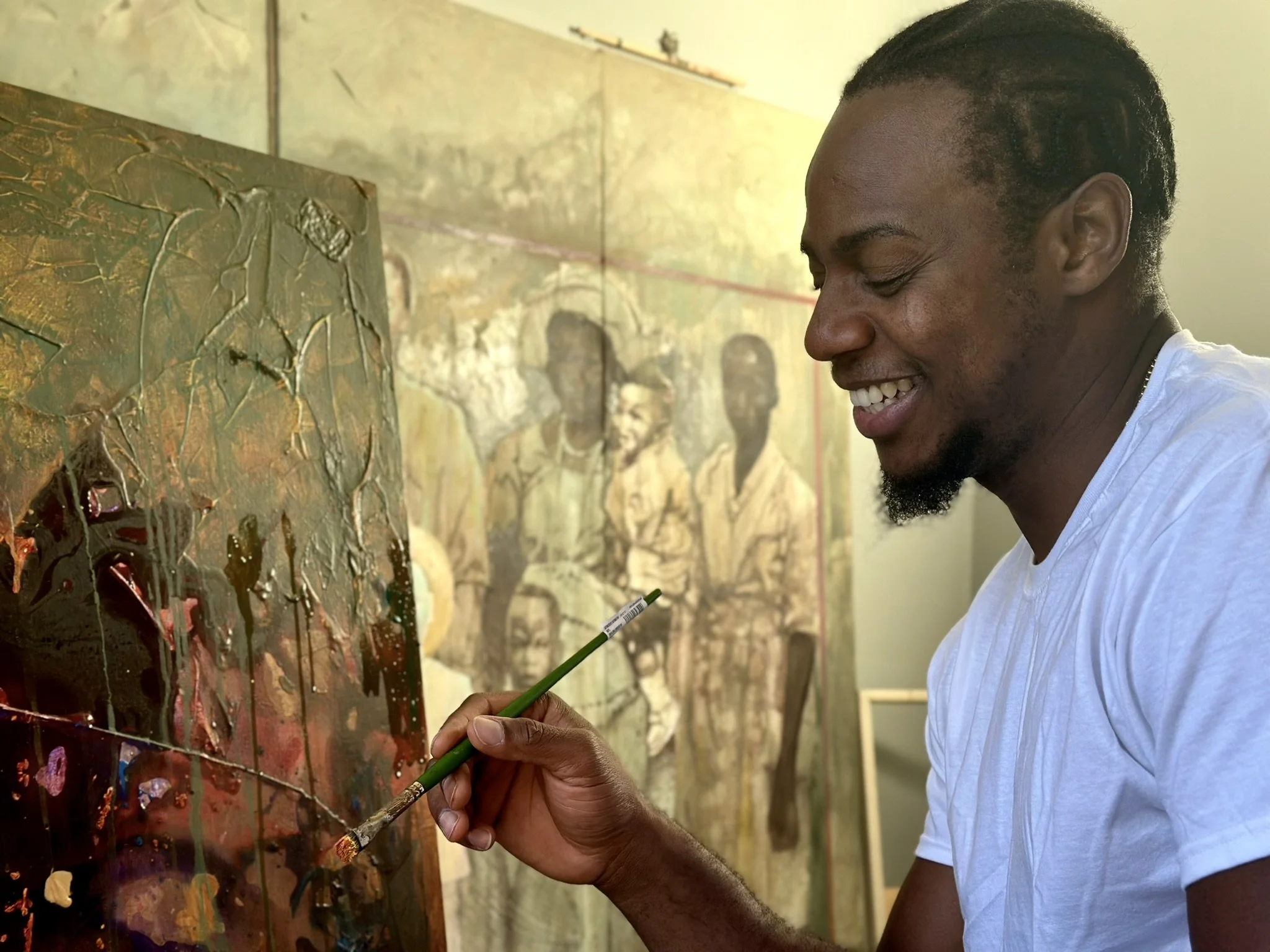
Biography
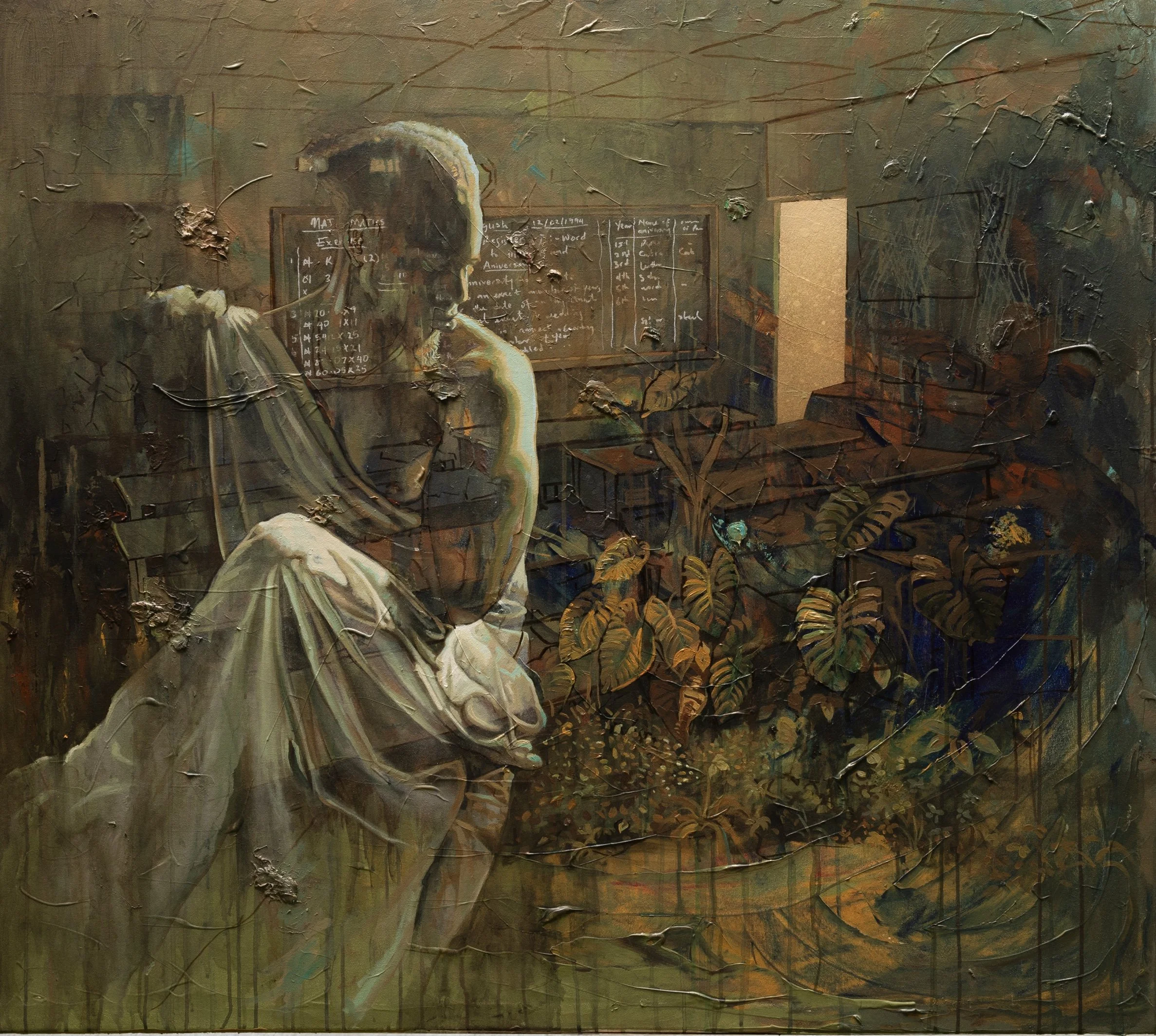
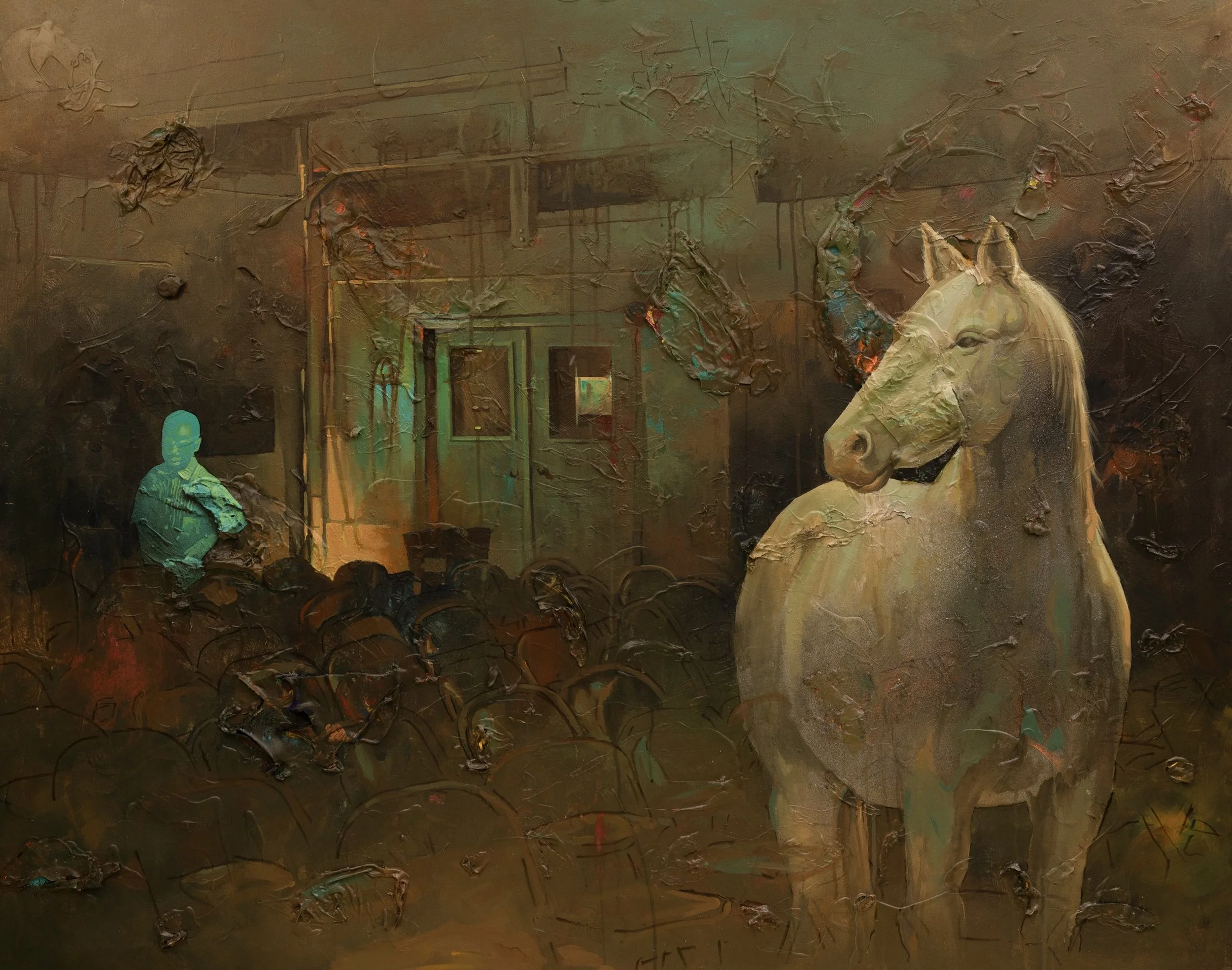
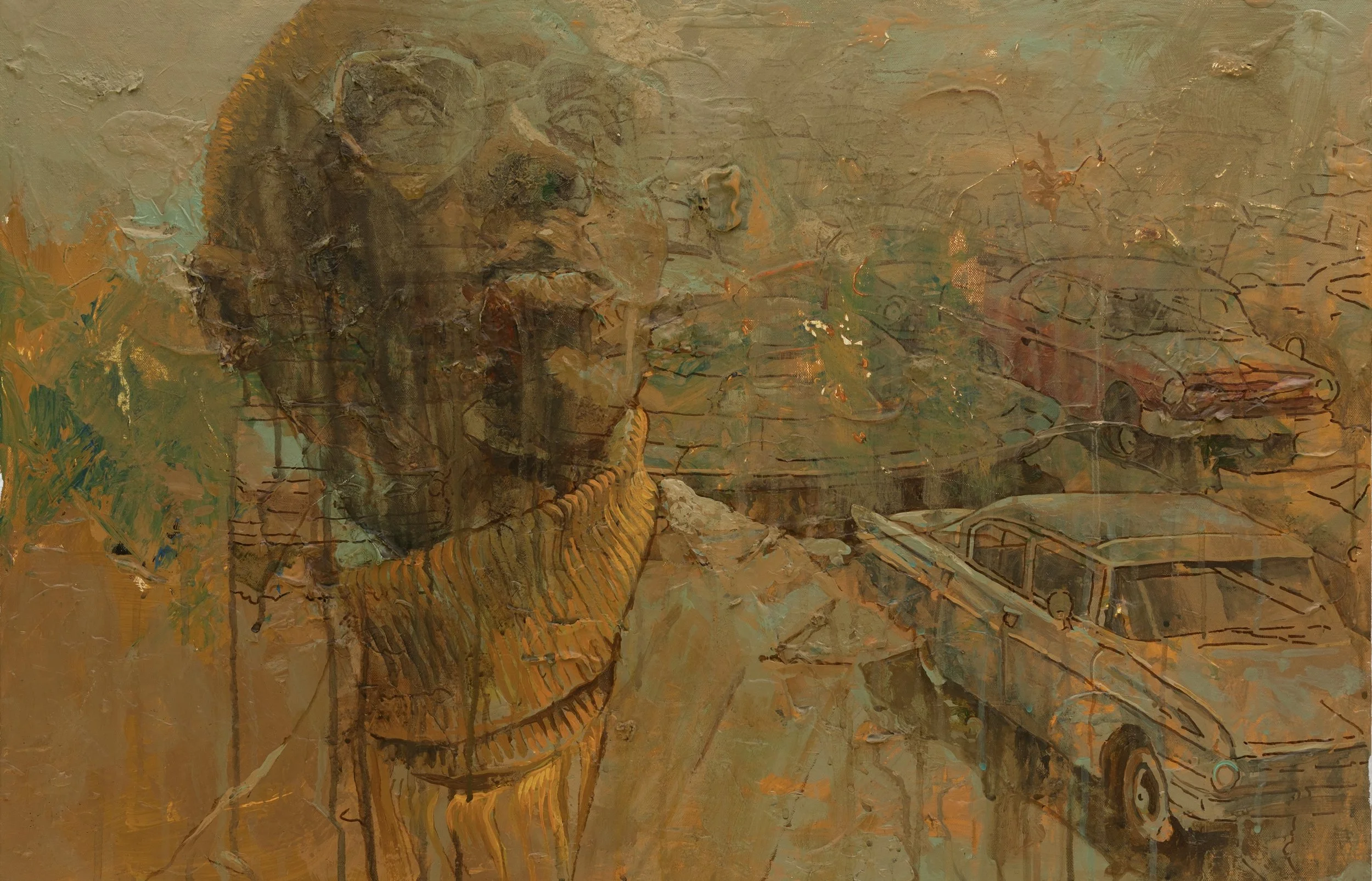
Omeh’s work depicts fragmented memories of his childhood in Nigeria conflated against his current day experiences in Atlanta. Recollection, particularly that of his formative years, is a central thematic in his work. Growing up as the youngest in a very large family.
Omeh fought to prove himself and make his presence known, reflecting in later life that ‘attention is the most important human connection’. He struggled to read and write as a child and considered himself to be a slow developer, as expressed in the work ‘Parable of a Late Bloomer’. Unable to communicate through traditional forms, he started painting as he found it to be the most effective medium through which to express himself.
His work often features children and bold colors that appeal to a universal eye, and in so doing speaks a common language that is uncomplicated, and illustrative. In a similar vein, one can find numerous references to schools and classrooms in his work, for example the black and white tiled floors and the mathematical.
Chinemerem 'Eme' Omeh (b.1994, Nsukka, Nigeria)
Born in Nsukka, Nigeria, and obtaining a BA in fine and applied arts from the University of Nigeria, Omeh is a visual raconteur, with multi-faceted and layered canvases that are rooted in a tradition of storytelling, often referencing parables, myths, and personal fictions.
Video
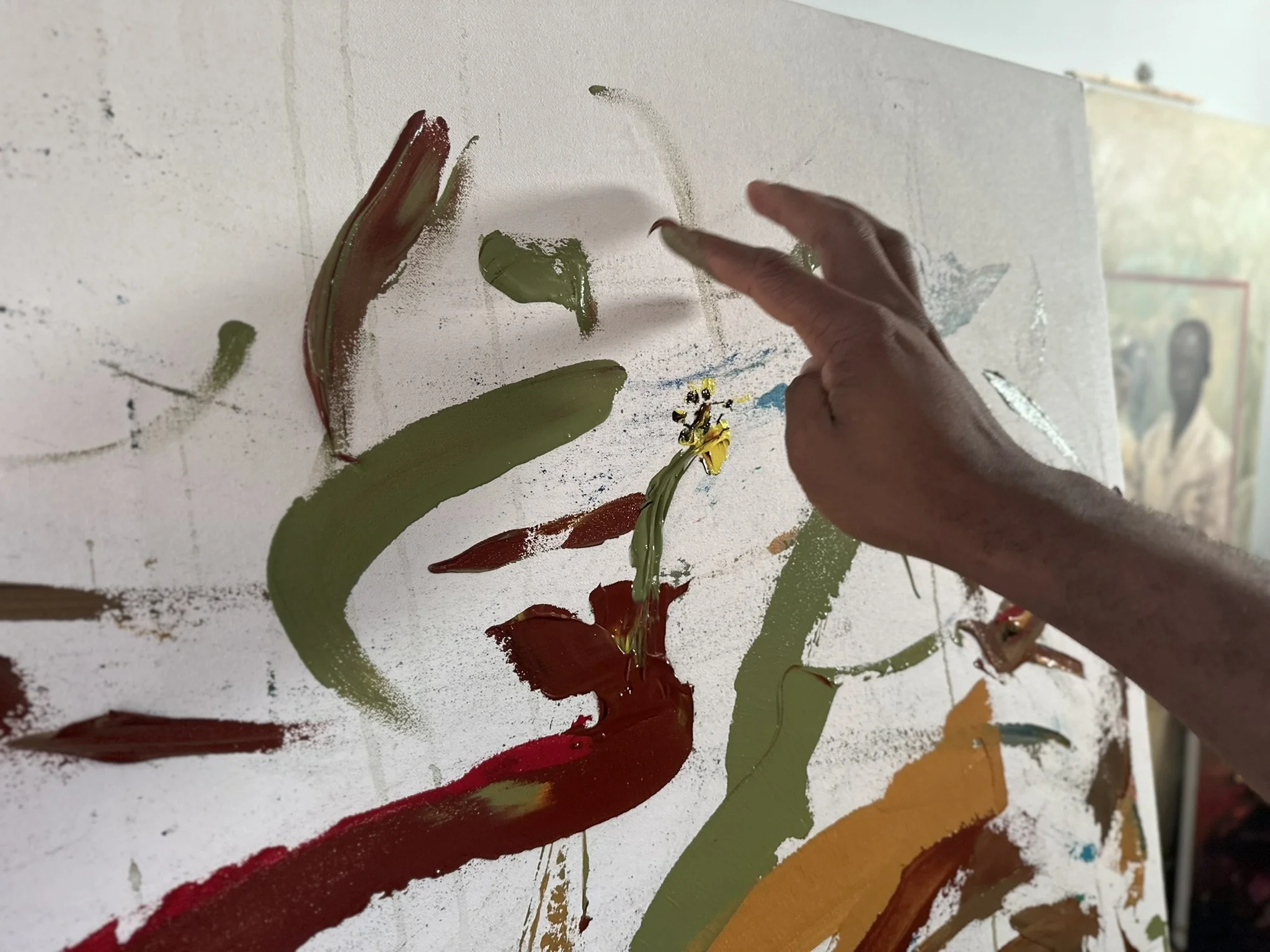
Work-in-progress
The Interview
-
Speaker 1 (00:00:00):
There we go. All right. You said something a minute ago when he was bringing down the stuff from upstairs. You said are? Yeah. Okay. You're okay. It's not going to hurt. I'll put 'em right there. You can see him.
Speaker 2 (00:00:13):
You
Speaker 1 (00:00:13):
Want see him or not see him?
Speaker 2 (00:00:15):
I don't care.
Speaker 1 (00:00:16):
Okay.
Speaker 2 (00:00:16):
I just want to be short on my voice could get to me.
Speaker 1 (00:00:19):
Oh yeah. I had this in my pocket once. I did one with it in my pocket. The sound person was very mad at me. But that's how it,
Speaker 2 (00:00:26):
Should I turn off the music?
Speaker 1 (00:00:27):
If you want to, it's up to you.
Speaker 2 (00:00:29):
This is your show.
Speaker 1 (00:00:30):
[00:00:30] I'm not going to hurt anything.
Speaker 2 (00:00:31):
Okay.
Speaker 1 (00:00:31):
What I do is when I'm done recording, I'll put it through translation and it gives me the transcripts and then I extract from that. So,
Speaker 2 (00:00:40):
Oh, it types down what I've said in a way. So really they're not going to be hearing my voice. They're going to be seeing my title.
Speaker 1 (00:00:49):
Both. Both. The whole interview will play on the site if somebody wants to hear the whole thing. If you're okay with that, you'll get to hear and see everything. You don't need to. [00:01:00] You said something over here when he was bringing it down, you said, my studio could never be down here because what I'm doing is emotional and serious and you wouldn't want somebody to interrupt you or be in the middle of that. So talk to me a little about what is it like when you're painting? It doesn't sound like you're painting. It sounds like you're translating or something.
Speaker 3 (00:01:22):
Yeah,
Speaker 2 (00:01:30):
[00:01:30] I mean, I think most artists, they're always painting in their mind. If you're an artist, you mustn't be in the studio before you paint. The ideas that I have for my works, they're not just always is not random. It's almost kind of premeditated. Then you have this peculiar [00:02:00] form of expression regarding a particular story you want to tell. So you already have the vibe of what you want to do and most of the time the vibe is my upbringing, how I grew up, the things I have to endure, the struggle I have to go through and the road to triumph. In that way it becomes very emotional. It becomes very real because it's a life I've lived. If I want to paint them, I have to relieve them. In my mind. I'm painted them in my mind. Oh, you have to go
Speaker 1 (00:02:28):
Back.
Speaker 2 (00:02:29):
Of course.
Speaker 1 (00:02:30):
[00:02:30] To conjure it up instead of just looking at it, you have to, do you feel it again? Do you ingest it again and
Speaker 2 (00:02:37):
Yeah, you relieve it in some sense. And part of why I'm doing that, I enjoy it. First of all, it gives me the confidence as someone who struggle with illiteracy, someone who really didn't know much in his life. When I'm talking about being able to read, being able to have voice, being able to sing as someone who knows [00:03:00] something, I've always been looked upon non-existent and that's how I grew. So for me to do this, it's not a space whereby anyone can just walk as I'm painting and people are, I want my space and when I'm done, when you gaze upon those pieces, you start feeling kind of relieving your own memories. Like vicariously through my tenant. I'm saying, and that's why they're dipping that I don't want people to come that way of
Speaker 1 (00:03:29):
Expression. [00:03:30] When you're thinking about that, are you also reliving to heal? Are you just reliving to express and to kind of point out, I overcame this to be here? Or what makes you want to revisit? Because you classified the struggles, so what makes you want go back?
Speaker 2 (00:03:53):
What makes me want to go back? First of all, if you think my paintings are interesting [00:04:00] or my story is interesting, I'm even more surprised by my story. I'm a surprising a stranger because I'm able to go off my body and look at what I've been through. How is even possible that I can speak English? I am not relieving them in a way of pain. I'm relieving them in a way of surprise. How is it that this man or this young boy who was totally unable to have a form of identity? All I wanted to do was just to lean towards those people that have known or the intelligent people. So [00:04:30] I maybe look upon as intelligent.
Speaker 2 (00:04:32):
I saw other kids who could read, who could write as superior things because I could not read. I used to be that person that loved me. You know what I'm saying? Just be my friend in that sense. But something changed or what changed? I am my own person. I have a sense of purpose. I'm no longer crying for a sense of belonging because I've created this ecosystem for myself that I can exist. So it's not pain. I'm relieving. I'm relieving surprise and gratefulness. And sometimes I [00:05:00] know there are kids who are still going through what I'm going through, not just kids, even adults. We have little 5-year-old that live in each of every one of us. I still have my struggles and difficul because as a human being, you must have something you're trying to overcome that makes us alive.
Speaker 3 (00:05:14):
Yes.
Speaker 2 (00:05:15):
And that's what I'm believing. I'm just trying to, just being human telling stories through this piece of people that are still struggling. Whether you're a kid or an adult, you can take inspiration by courageously and heal.
Speaker 1 (00:05:27):
Yes, and heal. And that's where I wanted to ask you about [00:05:30] the first question about what makes you relive and then the question I was talking about, you go back, are you, each time you're healing because you're gaining strength and confidence from it and it is actually something that took it away then. So it's interesting how you've managed to relive it to build you up versus what it did at the time, which was keep you where you were. So
Speaker 2 (00:05:54):
I took profits from my loss.
Speaker 1 (00:05:57):
Yes, yes. I mean, that's hard [00:06:00] to do. A lot of people don't want to relive because they can't do what you did. They just come above it and went down on it as, oh, I've been through this and now here I am. And that's something to celebrate, not something to kind of live in and not grow from it. I don't know. I think there were some people that struggled like you did that still are so harmed by it and never really got to figure out how to grow. So let's talk about that for a minute. Five years old, [00:06:30] you started painting, but you endured.
Speaker 2 (00:06:33):
Can I say something about the five years old?
Speaker 1 (00:06:35):
Yes.
Speaker 2 (00:06:37):
It's not like it's five years old and I start painting the age to it is just to give a sense of reality. If I say I've been painting since I was little, you may not. I just want to host something, but I've, I've always been sy the way I talk, the way I dance, way I express myself. I was just a little unusual.
Speaker 1 (00:07:00):
[00:07:00] Well, you say too about even now you say I'm always painting in my head. It sounds like it's always been true.
Speaker 2 (00:07:10):
Well, I can see how that is true, right?
Speaker 1 (00:07:14):
Maybe. And maybe in a way your path is fortunate for you because if you would've been like we talked about upstairs, funneled into that same, it would've taken away what makes you you now. Absolutely.
Speaker 3 (00:07:30):
[00:07:30] Is that question.
Speaker 1 (00:07:33):
No, I was just seeing if you adopted, because I have to just put things together as you say them and say, and then I test them back and see is that where, and then you correct or refine the five-year-old thing. Right? It's you wanted to give some sort of context for how old and at what stage and all of that. So that's fine. Every time you come in here, there's more food. So now I want to get away from [00:08:00] or step away from the work directly a little bit.
Speaker 2 (00:08:03):
Share that. You can shoot a picture of this conversation. Just take it in the,
Speaker 1 (00:08:11):
I want to go to the person, not how the thing manifested itself into art. We were talking a little bit about that and I see it, but now I want to go back to, let's go back to 5, 6, 7, doesn't matter. And you're feeling how you feel. So talk to me about how you feel when you're 5, 6, 7 around in there.
Speaker 2 (00:08:30):
[00:08:30] To be honest, life wasn't real. I'm not a medical practitioner in a way that I understand neurology or I understand the human brain and how it translates to behavior. But I think my might not have fully farm to grasp society and its function [00:09:00] the way that it function for a five year mode. However, because I didn't see reality, the way they saw reality. I just wanted to play. I just wanted to be alive and breathe and play. And they took me to this place they called the school. They wanted me to study, they wanted me to, people may call it being dyslexia, but it's beyond that a little bit. They just wanted me to be in this school with this case. They gave me a piece of paper to write on it.
Speaker 2 (00:09:28):
I don't know what you're talking about. [00:09:30] Write work. Teachers are talking. Everyone is trying to make sense. I'm not making sense of any form of reality. I wasn't existing. I, I didn't understand it. And I'm trying to communicate that to my teachers, to people that level me dumb because at the end of we do exams, we write results. At the end of that, I'm always last position. And as I'm trying to, [00:10:00] I don't know what I'm doing here. And if you fail, definitely my mom is going to beat you up. I get that beat me so bad failing I and I believe that was who I am a failure. So yeah, you
Speaker 1 (00:10:11):
Started thinking right, because
Speaker 2 (00:10:14):
Yeah, I'm a failure. You can't read, you can't succeed. That's who you are. You have to be something at least. And that was the identity I had. If I see people read, I wouldn't even try to read because, so I was existing then as I didn't know what I [00:10:30] thought school was a playground and I was playing. Whenever we are in the class people, we are writing exams or whatever. I just copied from people. I wouldn't say copy. I draw their handwriting. I don't know what I'm writing.
Speaker 1 (00:10:43):
Right.
Speaker 2 (00:10:44):
You just drew the shapes. Yeah, I'm drawing and drawing. They weren't letters to you. They were No, they weren't letters.
Speaker 1 (00:10:48):
Yes. Yes.
Speaker 2 (00:10:49):
So even till this day, there is a way I saw mathematics because I never understood math in my brain. If you ask me figures like 450 times, three or times, whatever, [00:11:00] the way I'm seeing it in my head out like shapes. And I caught that shade if time divided by, I cut it down and I'm seeing size set of numbers. And when I see the size of heart, I give you the answer. I mean it may not be exact. It's going to be very close based on how I caught it. And I've tried to explain this to people, I don't even understand math, but how I solve it is true shape and content. And that's how my brain has been wired till this day.
Speaker 1 (00:11:26):
I think you're saying something extremely important [00:11:30] that we're just trying to understand. And it's funny because I think as a world we're coming at it and I have a US perspective. So
Speaker 3 (00:11:37):
Forgive
Speaker 1 (00:11:37):
That. We're coming at it from a medical brains work differently and brains work, but it's not changing how we're looking or treating people over here in the education system. So I think there's awareness over here that people's brains work differently, but we're not allowing And we're not letting because we're processed. That's right. That's right. So I think what you're saying is actually really, I almost got a little [00:12:00] theory because can you imagine, and it's funny because I'm going to say this to you and you've lived it, can you imagine being in a place where you think differently and then that's told that that's wrong and that's how you're wired. So I'm talking to someone who that happened to. So that's how you felt at that age. What did you paint at that age?
Speaker 2 (00:12:25):
Images of the pictures I found on my textbooks [00:12:30] movies. Jackie Chan, Jackie Green. Yes, Tommy Nate or Spider-Man, Superman. It was just interpr and that was the only thing that gave me jewelry.
Speaker 1 (00:12:44):
What attracted you to that? Was it just the shapes and colors or was there some inherent Because Spider-Man is different. Those characters are innately different from everybody else. So I don't know if it was that
Speaker 2 (00:12:56):
Deep. I think at that age you're just attracted to reality. Anything [00:13:00] that you're tab in that sense and you're just starting to acquire information from anything around you. And I was like a sponge that took in some and some wasn't able to digest or I digested it in my own realm of understanding. But
Speaker 1 (00:13:16):
It wasn't in the construct of education with it.
Speaker 2 (00:13:18):
Exactly. So I just, whatever movie post that we have, whatever, and I and very, very little, I've just had a natural intuition to just [00:13:30] express, draw. Just
Speaker 1 (00:13:35):
It comes out of you that way.
Speaker 2 (00:13:36):
Yeah. Her
Speaker 1 (00:13:36):
Expression is in.
Speaker 2 (00:13:38):
Yeah. And my brothers. So I come from a family of seven.
Speaker 1 (00:13:42):
I'm
Speaker 2 (00:13:42):
The last and the runs of the family.
Speaker 1 (00:13:49):
Which compounded how you were already feeling.
Speaker 2 (00:13:52):
Well the part of the luck that I have, I was grew with a lot of love. It was a lot of love. I never saw my dad scream at my [00:14:00] mom or beat her or smoke or drink. It was just a wonderful, peaceful family. Everyone was just a love love. But even with love, no one understood me in that way. They just label me as someone who you're just dumb. And I'm like, that's who I'm, did you believe it? Oh, very much so. I believe you. Because there was nothing else to rely on. There was nothing. I'm a realist right from when I was little. To this point, if white is white, white is white, brown is brown is brown. [00:14:30] One plus one, two and I'll follow it up. That's how a bold has been. So I'm failing in school and they're telling me I'm dumb. It's true. I'm dumb. Therefore I'm dumb. I'm dumb. Why shouldn't I believe it? Can I prove them wrong? No, I cannot. And some events, I've been telling this story every time this I'm about to tell you, I've told this story like three different locations. I'm going to tell you Same
Speaker 1 (00:14:52):
Sir. Yes.
Speaker 2 (00:14:53):
My mom is a typist. She was a typist. She's secretary [00:15:00] to. And as the world moved on, typewriter is no longer the equipment, computers to cover. It was old and probably rusted with old ink on it. My sister was typing everyone's name on the typewriter. I'm the last she wrote my dad's name, my mom's name, sister gaze, sister Barry sister former, her own name, puka. I'm the last. She was about to type me. My name wasn't coming out [00:15:30] on the P sheet. I'm like, why is my name not coming out? She told me that the typewriter is smart and I'm dumb. It's not going to come out because I'm dumb. I was very little when that happened, but I believed it. So I have no place in this world because of that kind of reality.
Speaker 1 (00:15:45):
It hurt just hearing it.
Speaker 2 (00:15:47):
But she didn't even mean that. And
Speaker 1 (00:15:48):
I'm not. I know, I know. But that's how it becomes to your point, it wasn't mean. It wasn't vindictive. It was just the way it was. [00:16:00] The way they walked. Yeah. Woo. So, okay, so this is your world, right? Where we're mucking around right now. Is your world a little bit older? What happens? What happens as you get a little bit older and you experience things and are you breaking away from that and saying, wait a minute, am I not? When did it start to dawn on you that I'm not dumb or did that not and you just found a different way and always had that Or when did it start [00:16:30] to change for you? Or was it very slow over time? Was there, yeah,
Speaker 2 (00:16:37):
It was definitely soft pedaled. It wasn't a halt, it was soft pedal or it was portrayed at cause of a lot of struggles. I think when you keep saying that, and by the way the first language in Nigeria is English, but ethnicity have their own dialect. So if you spoke English [00:17:00] was for, everyone's supposed to know how to speak English. I didn't speak English very because I didn't understand it. IBO was what I spoke. I ibo, I like to speak ibo. I don't want, but I'm going to school. You have to speak English in school. And I wasn't able to speak English that much. So that limited also my interaction with some kind of friends and I just hang around people that can speak, people that I speak. If someone looks for my trouble, a kid hits me. I cannot, [00:17:30] I'm definitely going to hit you back. But if we go to the teacher, I can't defend myself.
Speaker 1 (00:17:35):
Right. You can't explain and you look. Yeah.
Speaker 2 (00:17:38):
And that also made me believe I was dumb. So the road to prime was farther away from me. So I would say I keep on growing and growing until I started solving problem myself. Maybe something is going to happen, I give an opinion and people were like, okay.
Speaker 3 (00:18:00):
[00:18:00] Right.
Speaker 2 (00:18:01):
People can respond to my opinion. But before then, when I did the drawings, people were all like, yo, you're so talented. I was 11 years, 12 years old when I won the best artist in the university of primary school. I was just
Speaker 1 (00:18:13):
In Nigeria
Speaker 2 (00:18:14):
In my primary school. I was the best artist. They gave me the award. I'm like, this is it. Because they keep calling it best mathematician, best, best in English, best in geography, best in social studies, best in Christian religious setting, best in physical [00:18:30] activities. And they called best artists. I came up there, I say to myself,
Speaker 1 (00:18:36):
Felt like everyone else
Speaker 2 (00:18:37):
For, I'm like, if these people I know I have no place in royalty. I have no place in SUEx that it is not meant for people like me. I'm not supposed to be there. And one day they just called chin me on my best artist. I ran up the stage and held the poster color that he was a gift. There was an award held. Did they? Two picture. I'm like, this is me. In my [00:19:00] mind, I was so happy because it finally something that we Yes, something. Feel it now. Yeah. Do you still have that? Huh?
Speaker 1 (00:19:09):
Do you still have whatever
Speaker 2 (00:19:09):
They gave you? Oh, I use it to paint.
Speaker 1 (00:19:12):
Of course you do. Course used. That's why when I said your palate is your blood and your gut. Yeah, you're right. That's fantastic. Okay, so let's go there. Let's go from five. I'm really getting in there. Aren, [00:19:30] I, sorry. So we go from five, six, whatever to 11, 12. Best started back around in there. Right?
Speaker 2 (00:19:36):
I think it is very important that I mentioned that that moment as you're asking me question, I'm tasked to go over the os of my memory to relieve some things. I'm like, that's actually one of the most incredible moments of my life. Hour. Of course
Speaker 1 (00:19:50):
You're validated.
Speaker 2 (00:19:51):
I've not been able to think about it. I'm just thinking about it. That's literally my point of transformation.
Speaker 1 (00:19:56):
Brilliant. That's perfect. But let's take your art along [00:20:00] with you, right? You were doing Spider-Man, Jackie Cha, all of that. And then it started to transform. When did you start your own view and not emulating? Oh, Spider-Man, I'm going to draw Spider-Man or this, I'm going to draw. When did you start doing that? I hope you're hearing some of this. I am. It's amazing. Thank you. I love it. I love it. I really do. Thank you. And I know you have to go [00:20:30] back, so take your time. No, we got enough.
Speaker 2 (00:20:35):
I've always been an artist that imitates reality.
Speaker 1 (00:20:38):
Yep.
Speaker 2 (00:20:39):
Wow. Yeah, I've always been copying from things and making it my own. So throughout my secondary school, which is high school, I was still imitating See down, I drop people sitting down. I keep imitating from books. I've not really had my own school of thoughts and principles. I've not even revisited my childhood or whatever. And [00:21:00] another story you may like that would lead to all this. So in doing all of this, my dad is just a sweet guy. He's just sweet. Sometimes I say to my girlfriend, I don't want to be like my dad. He's too sweet. I want to be a little, be a little here. Keep him sweet when I'm, I don't agree with what you're saying.
Speaker 2 (00:21:30):
[00:21:30] To get admission into high school, they have cut off mark. So maybe 400 students or 300 write exam. They're going to take only 220 and they're going to score it by the first person, second, third. But if you find it in your pack, but they're going to grade it for you to see how poorly or how nice you perform. Thank you. You're right. I came 212 out of 2 22 18 or so. Out of two 18. So I was [00:22:00] right at the bottom. I just went there to see man and the guy ordered on me. My immediate elder brother Iha very intelligent. He didn't have to be my brother at that time because he was too smart. The ya of measurement was him and I was this.
Speaker 2 (00:22:18):
She had both ends of the, he always know the right thing to say. He knows how to smell good, dress good. I was just a dedicat kid, but you can't paint. [00:22:30] So he went with me. Sorry. I went to the school to check if my name was on the school board, went to the school board and then I was just looking, everybody was looking. I saw my name. I was, yeah, yeah, people like why my network was hundred and 50. She was so sad. I was 200 and so I was so happy. My name is there, I'm going to high school. I don't care.
Speaker 1 (00:22:51):
Yes, you don't know what
Speaker 2 (00:22:52):
I've been through. That's been your
Speaker 1 (00:22:54):
Life anyway. You're used to being right there.
Speaker 2 (00:22:56):
You just want to be in the mix. I didn't [00:23:00] want to be left out and well then we'll help you through out that. That's a very important piece. Yes.
Speaker 1 (00:23:08):
It's a very important piece. What him or the painting?
Speaker 2 (00:23:09):
Remember the tab that's painting.
Speaker 1 (00:23:12):
Oh yeah. It
Speaker 2 (00:23:12):
Speaks about neurology.
Speaker 1 (00:23:16):
We will let stay here for a minute you, let's talk about that. So I want to go back to Spider-Man and Jackie Chan. You're looking at life and drawing it [00:23:30] and drawing it. And then you said something, I want to just ask for a minute or dig in a minute. You said I started drawing someone in a chair and blah blah blah. You're still trying to get in or to capture or to figure out or to when you were talking about transitioning from drawing those types of things to, did you start drawing people you saw or life you saw? Because that makes sense to me that you would want to capture it because you, you said you didn't feel like you belonged anywhere [00:24:00] and it makes sense that you would try paint it how it express yourself so you could access it. Is that what was going on? Or think about that for a little bit.
Speaker 2 (00:24:09):
I wasn't that sophisticated in reasoning at that time.
Speaker 1 (00:24:11):
Well, you didn't know it at the
Speaker 2 (00:24:12):
Time. I didn't know it. So we kept on copying image until I got into high school. I was copying image finished up and about 18 years was when reality started making sense to me. When I got into the university, the tax of being human became more realistic. My realities became more [00:24:30] pronounced and
Speaker 1 (00:24:31):
Well, you had to have confidence because you wouldn't have applied or is it automatic to go to university?
Speaker 2 (00:24:37):
So in Nigeria is you have parents that you can't disobey tell you what to do. Do it.
Speaker 1 (00:24:46):
Yeah. Right.
Speaker 2 (00:24:46):
So you know that
Speaker 1 (00:24:47):
I have that parent
Speaker 2 (00:24:48):
Here. Exactly. Carmen, X, Y, z, you are going to school is normal thing. And everybody knew that I was going to study art, but my dad asked me a question, is this what you want to do for the rest of your life?
Speaker 1 (00:24:59):
That's [00:25:00] a sweet
Speaker 2 (00:25:00):
Dad. Are you going to use this and feed your family? Are you going to paint the president of Nigeria or the president of America for you to have money? Would this pay your bill? And I'm like, yes daddy. But I was telling a story about how I was, I was the last and why I said he was a sweet dad. I came home to tell them my position he was eating from his food. He just gave me his meat. And the that on meat is something huge just because I passed and my brother was saying, man, narrowly escaped. [00:25:30] That was what he said. Well he didn't do so he not really escaped but that he's there. Take the meat. So he has had that ideology of very little. He's okay with very little achievements in that way. So after those questions, I was then in school, but the university I went to when I was as young as nine 10, that was the age my mom [00:26:00] saw that I was drawing so much because she beat me up real bad to stop drawing because that was a distraction.
Speaker 1 (00:26:05):
Yes, I saw that in one of your things.
Speaker 2 (00:26:07):
Yeah, beat me up. Yeah. So she with her hands, took me to the university when I was still in primary school to train with the university students. So that helped me a lot to have foundation. More
Speaker 1 (00:26:22):
Like tutoring. Tutoring,
Speaker 2 (00:26:24):
Yeah, tutoring. It was more so to learn being around them, you seeing what they're doing year being previous. So when I came [00:26:30] back to university, it was almost like I've been here before as a kid and it's time for me to think like an adult and start reasoning for myself. And suddenly I started knowing things I could speak better, I can pick up things, I can understand what's going on. I can. And
Speaker 1 (00:26:46):
So it wasn't dumb. You understood it just
Speaker 2 (00:26:52):
Well the people there didn't know my story.
Speaker 1 (00:26:54):
Yes.
Speaker 2 (00:26:54):
So they didn't have to judge me. They didn't have just thought I knew what I knew and I'm talking everyone is hope is going ahead. And [00:27:00] from university I started understanding painting in a broader level of it's not just keep drawing, it's not just keep. And I'm looking at how do my lectures are talking. I'm listening to them a hundred percent. I'm still that child that knew that I always have the inputs that I know nothing. So I want to learn. So because I open my mind to, I'm telling you a hundred percent of what my lecturer said. I absorbed every single thing they said I listened to.
Speaker 1 (00:27:30):
[00:27:30] Did you open your mind or was someone finally saying something that resonated?
Speaker 2 (00:27:34):
I opened my mind very much.
Speaker 1 (00:27:36):
But
Speaker 2 (00:27:37):
I had mentors here and there that showed me the way, just keep drawing, keep walking. But I have friends that are talented. I have friends that understand reality in their way that I took a huge chunk of their personality and filter it to my own understanding of life. I keep doing that to this day. Just spicy people. [00:28:00] I get involved with their energy, understand them in a way, not in a manipulating way but in a way of what can I learn and just keep absorbing and putting what, that's how I keep, I kept on growing and confidence kept on growing. Till I finished school, I was just doing assignments and pushing boundaries of what I wrote till after university. I left university and I thought to myself, I'm done with all this. I can't keep painting. My old works, my university [00:28:30] works at upstairs, literally my university assignment, they're upstairs. I can't keep painting people like smooth painting. What am I trying to tell a painting seat?
Speaker 2 (00:28:42):
That's not me. I'm done with the assignments, I'm done with the school curriculum. I'm done with the social mechanism. That curriculum don't fitting in. I want to be, how do I, me and every day I still speak to my confidence level. Who are you really? [00:29:00] Are you sure you're not still that little kid that is afraid of everybody that has no self-belief, that have lots and loss of energy? You are still if you are not, who are you? And that question, who are you? What are the answers that these converses are providing today? Discover itself. And like I said before, there are pathways to help other people looking at it. To vicariously lead their life through dependence.
Speaker 1 (00:29:27):
Yes.
Speaker 2 (00:29:27):
Because one, five years every year. And there
Speaker 1 (00:29:29):
One of [00:29:30] the things I found on you, you said, I finally am where this is what I'm supposed to be. This is
Speaker 2 (00:29:35):
What I'm
Speaker 1 (00:29:36):
Supposed to be.
Speaker 2 (00:29:36):
Yes.
Speaker 1 (00:29:37):
And that's what I wanted to just go all the way back to bring me forward is how did you get there? I think if I step back to what I want people to do is about nine or 10 years old, people that draw or paint or play with clay, whatever, stop doing it because they're not good. People start judging at that point [00:30:00] when you're really little they're like, oh lemme put that in the refrigerator. It doesn't matter that your lion is blue or whatever. A tree is purple. But eventually we start the exact same thing. That kind of construct of oh it has to look like this. The leaf has to look like this and it has to. And so people stop creating. And I think there's so many people that would express themselves but they can't because they're worried about the outcome. Will it make it into a gallery? Will someone think it's good? Is it frameable? Instead of just creating and expressing. So I wanted [00:30:30] to hear from you, what kept you going? What kept you painting
Speaker 2 (00:30:36):
Quest for identity? I knew that it is almost like
Speaker 1 (00:30:41):
I was the quest for identity.
Speaker 2 (00:30:42):
Yeah,
Speaker 1 (00:30:43):
Yeah.
Speaker 2 (00:30:43):
I knew I was a nobody and I believed that and somehow I had a voice. How did you have that voice through art? So I'm a hundred percent faithful to this cause in the detriment of my sanity, I'm a hundred percent faithful to excellence, perfection in the creative endeavors because [00:31:00] I was picked up from the mold by this energy. I can't even describe art doesn't pay and sometimes it pays a lot. Sometimes it's when its in somebody's rainy season, sometimes it's famine, sometimes it's dry season. I don't look upon it as how much can I make from this? Because there have been times where you'd be like, this is not the right thing to do. If I want to pay my bill, if I want to send some money [00:31:30] home, this is not how you are supposed to survive. And I never gave up on her.
Speaker 1 (00:31:53):
And I would say if we talk about the word success and all that, that is to know that is successful. [00:32:00] The most success you can have is knowing what you were meant to do and then doing that thing. Hands down, so many people that live their life for four hours on the weekends or one hour at night and the rest of the time is wasted, forced into that funnel that you wanted to be in. But then realize you shouldn't have been in it from the beginning anyway. Did people's opinions start to change of you as you got [00:32:30] older and they saw your work and you got the heart?
Speaker 2 (00:32:33):
People don't really have opinion. What I have is just what's in front of them, the general public, the united unanimous, should I say prim instinct or social construct? We don't have opinions. Reality controllers, we don't really have genuine opinion. We just go by what people, they don't really care actually if you are, I didn't make it. If I didn't keep doing what I dealt, they're just moved by what they're [00:33:00] saying. They don't go beyond this surface. I didn't have to be selling my pennies or to live in America or to travel for them to believe. All you have to do is the rawness of the talent and the wheel to do what I'm doing. But their process already, they're already co-opted by the social mechanism. So the opinion are almost like, I mean validation is good. It helps you. But when the curtains are closed, your up alone, your own motivation, [00:33:30] what they saving may not really hold that much water for you. So the opinion definitely will change. Likewise, everything that comes with beauty, the see, smile, it must change. Of course it's changed because where we are.
Speaker 1 (00:33:46):
Right. Did you ever have a period where you didn't paint?
Speaker 2 (00:33:55):
Yes.
Speaker 1 (00:33:57):
Say more words.
Speaker 2 (00:33:59):
But when I [00:34:00] say didn't paint, no. And yes, because I'm painting not just in my mind, I am always drawing. Drawing is kind of food for thought. You are drawing to keep the spirit awake. I wouldn't say I am not painting because what I pick painting today is waking up every morning. The first thing I do before [00:34:30] I brush my teeth, before I wash my face is to carry my UL's body on the canvas and dump it there. Even if I'm not painting, I'm just sitting on before my canvas and I'm having that conversation. And a profound is that is if you have the understanding that what you have as a person has the capacity to change lives based on what you've seen in your shows, in your galleries. How this painting has made people feel [00:35:00] is attacks beyond your own self gain of expression that you have a cause. Just the same way a pastor has to preach the same way a doctor has to perform surgery the same way a postman have to deliver the mail. I have to deliver these emotions for without vi trail to exist. So it's no longer about my own tus, but it's attitude of mankind. When I say this is who I am, this is who I am because I am, I hold faith that I have a tax to deliver.
Speaker 1 (00:35:29):
What would make [00:35:30] you stop?
Speaker 2 (00:35:31):
What would make me stop?
Speaker 1 (00:35:45):
I don't think I messed up. Most everybody's answered that way. Yeah.
Speaker 2 (00:35:50):
I wanted be sure I I wanted to be sure you lost my, I appreciate thought if I lost my arms, I thought about that. If I lost my two legs, my two arms, I would put a brush in my mouth [00:36:00] and move it.
Speaker 1 (00:36:00):
I believe you. Because your brain wouldn't stop. And it's like you said, it's interesting what you said about my comatose corpse and because you're right, the painting is part of it, but it's not all of it. It's what you were saying earlier about you're always painting in your head because there's a place that you're getting those ideas and concepts and then it happens to come out painting. But there's a whole bigger part of it than just the paint on the canvas part of it. Yeah. Otherwise it's just [00:36:30] that.
Speaker 2 (00:36:32):
But to your
Speaker 1 (00:36:32):
Point,
Speaker 2 (00:36:35):
You are trading in the boundary of my insanity because what you're talking about is part of the integral part of what I want to do in London. The show is way, way beyond. The show I'm doing in London is beyond the canvas.
Speaker 3 (00:36:50):
It's
Speaker 2 (00:36:50):
Not about the campus. That's what the culture is about. Oh great. I'm attracting people not to look at the canvas. And it's what, when you say it I'm like do you
Speaker 1 (00:37:00):
[00:37:00] Head No it's just you said it a minute ago, you said a couple of things you've said I pieced together. You're always painting in your head. And when you were just saying nothing was I put in, but the comatose thing was like ah. The painting is when you get to a certain point but there's so much happening before you get to that. And you even said it yourself, I'm expressing this is all this history and stuff that's coming out. So it's not that you got paint and put it on [00:37:30] a canvas. You had to lift that and it happens to be coming out that way. Yeah.
Speaker 2 (00:37:35):
It just so happened that colors are the end point of, I mean they're not the end point where they're kind of the universal particle or part of the cosmic energy that I drive down those points. It could have been any other thing. It could have been this tv, it could have been my clothing. But it just so happened cause what I recently thought, the energy as a painting I did that I could cosmic energy. I try as much as possible to capture [00:38:00] what I feel before the painting and that's what I painted.
Speaker 3 (00:38:02):
Yes. So
Speaker 2 (00:38:03):
The painting that bother a lot of catastrophe organization, this organization that come with life and things I've taught and things that bounce off me is just the end points. Well I
Speaker 1 (00:38:15):
And I think that can be true for a musician. It can be true for. So I think that's really interesting and a good point for people to remember is it's not about, and then it also gets out of the technique itself. It's [00:38:30] like you don't have to be a master at this to get this part and then you can work on this part, but you got to be in touch with something or otherwise it's just craft. It has to be based on something. You have to bring something forward. Other than
Speaker 2 (00:38:45):
There are many famous artists that are famous not because of what it taught before the painting, but because of what a curator thoughts about them and they become who they are. There are a lot of very great artists that has no thought process [00:39:00] behind whether they're just artists are painted and writers and people that are very good in words that come together, crafters and consecrate, whatever things they have done and add value to it and it becomes what it needs.
Speaker 1 (00:39:14):
I see what you're saying. I have an artist that I think of that way that I don't, I'm like, well you just kind of made that and it got popular. I'm not going to say who it is, but when I stop recording I'll tell you who I'm,
Speaker 2 (00:39:30):
[00:39:30] But I'm not even saying you need to throw shades on those ideas because we are all still existing within the parameter of creativity. It takes time to create. If I am not a garbage cleaner and I'm not an astronaut, my job is to paint. You've done a job, you've taken time away and energy, the ability to do work as an energy. You've chosen, not chosen not to be an astronaut. You've chosen not to be a garbage man, but to spend your time doing that. So you've [00:40:00] worked, you've done the work. And if you label yourself on artist, that's who you are. How far that work goes depends on your own reality or people that are able to write for it. We all share this space as creative, welcoming all manner of talent. But sometimes you are scared that other people that are supposed to be your colleague, they the intellectual landmass of creativity as you are doing some [00:40:30] things you don't understand that you may not say is an art, but then you all identify as the same thing then almost that kind of make you less relevant. But all these are ideologies, they're otro, they're exhibit, they're who has the Y thing to measure art.
Speaker 2 (00:40:48):
And when the line is blood, you start fighting, where do I belong? That's where identity comes in. Yes. That's where identity, this is who I am. Close your eyes, the door is shut. This is who I am. So no matter what those artists do, the people that [00:41:00] have no thought process, that's who they've chosen to be. When they have their interview, a writer can do whatever. But I in America, woman has hold faith. I hold faith that I'm here to solve. I wouldn't say I have solutions to problem, but I can stack up ideas in people to heal whatever pain they have. My pains are not beautiful. I keep saying it. I don't paint skins that are all beautiful flowers. They're all deep, deep seated emotions that are caked that deserve a tiny little bit of oil, [00:41:30] emotional oil to massage them and heal them. That's where I lie. That's a fine line that I trait to just help people feel
Speaker 1 (00:41:38):
Something. And do you think it's interesting you're saying that because the people that I have worked with on the artists that I've worked with this, it was only gut feel from their art. I knew nothing about them, nothing about their journeys, nothing about, I didn't look at what galleries [00:42:00] they were in. I just was like something something. And this was just on a website in bed at night overnight I was looking, I didn't just would look up things and they'd be like, and not that I was judging, I was just looking for there's something here. And that's why when I walked in the gallery I was like, okay, who's this? Who is this right here? And I don't know, maybe to your point there is the ability to look at it and there's energy coming out of it that somebody picks up on
Speaker 2 (00:42:29):
In certain [00:42:30] degrees. I'm happy that it made you feel that way. As much as those are not initial ideas for my creativity, my initial ideas is not to get people, but it's not part of it. It's not part of the healing process. I sincerely believe that those pieces of clothes, like all converses, that I've put something in them beyond color that has the ability to make people relieve a memory that was difficult. And after relieving it through those things, they can feel something
Speaker 1 (00:42:59):
Better.
Speaker 2 (00:43:00):
[00:43:00] I really do believe
Speaker 1 (00:43:01):
It. Yes. And with me looking at it, I was, when I looked at more than just the one I was looking to the left, I was like, I'm not even sure I lived what's in there, but I knew something significant had happened with that person and it wasn't just a person. Then I went, this is bigger. This is like he is just talking to [00:43:30] people. I might not even be one of them but I can hear it and that's kind of how it hit me. And that's so funny when the bloodline, when I was watching you to describe it and then there it is,
Speaker 2 (00:43:44):
You watch it on my Instagram?
Speaker 1 (00:43:45):
Yes.
Speaker 2 (00:43:46):
When I describe the bloodline and
Speaker 1 (00:43:48):
Yes, because it's that stupid commercial I told you about and then I was like, yeah, that's kind of like he saw things in the bloodline and then he turned it around. I was like, that was the one I'm talking. Yeah,
Speaker 1 (00:43:59):
No, but there [00:44:00] it's funny and I look at the journeys, the people that I work with and some of them are big corporate executive. They're a big company and always wanted to paint and she paints beautifully like that in a year. But she had not touched it but she's painting in her head the whole time. And then people had struggled with drugs or one of them, his mother had a studio up upstairs in their house and she had paints and canvas and never touched it [00:44:30] his life. She never touched it. She would just walk by it with one because she only had something to do in front of it, but it was there. So now he paint. So there's these journeys that have been interesting that people feel, to your point, their identity, they were living a different identity and eventually it caught up. Yes. You I would say are lucky because you followed it early on whether you wanted it or not.
Speaker 3 (00:44:59):
Yes.
Speaker 1 (00:44:59):
You followed [00:45:00] it early on and it was really close to you. Whereas these people went far away from it to varying degrees and it caught up to a much later in life. Most of 'em. Some of 'em just had disasters trying to follow it and trying to hold onto it of what you said. People forced them somewhere else or tried to force them into something else and it just didn't work. It just didn't work. So it's been interesting. [00:45:30] When you left university, how did you start to channel this type of, how did you realize this is energy and I want to channel it or is it like that? How does it come to you? How does it,
Speaker 2 (00:45:45):
You mean the kind of imagery and the kind of painting? There's so much there. I looked around and I studied other artists. I looked around what they were doing. Everybody [00:46:00] and most people I'm just researching. I'm just researching, seeing what all is because I was running away from beauty. I would say that my painting is very beautiful. I was running away from beauty is not real really melancholy. It's beauty in itself. [00:46:30] Just like a soft music playing. Yes. It's not exciting for a suit. So this is more so the pursuit of beauty led me to find melancholy. Clinton desaturated feel when a painting is less colorful, is [00:47:00] less chaotic, the less color you are coming in, the less outburst of all these different colors and shaved and structures, the less you have it in a more organized and disorganized form that is cleansing. Because I wash now most of my paint are dripping and you're sitting, you don't know what it's doing to it. But is the idea the subconscious idea of washing? Well I
Speaker 1 (00:47:25):
Thought you take a rag in one of your videos and you took red
Speaker 2 (00:47:27):
And yeah, you spray, you keep washing. That [00:47:30] feeling is what I intentionally want to capture. You may be seeing your feeling some but you may not really know. It's the wash you're seeing that is adding to the field of washing. So yeah, trying to find my own style and trying to ask myself about childhood. We are all used to the pictures taking the four colored. We are all in black and white and I was attracted to that. So to tell the story of yesterday, we have to tell it in black and white, which is more clarity
Speaker 1 (00:47:59):
Is
Speaker 2 (00:48:00):
[00:48:00] Also
Speaker 1 (00:48:00):
So you have those kind of
Speaker 2 (00:48:02):
Mute muted colors and little outbursts of chaotic that that's controlled little. Sometimes you see colors in my pain, they just pop over, they hold back themselves immediately. Don't scream too much. So they don't find out that we're getting excited. But the Ellie works, they are more colorful, sorry, darker because it was more struggle. Now you can see more calls because I'm getting more excited as a person. [00:48:30] I am living a better life in all ramification, but I'm going still deeper in my philosophies and my school of tours.
Speaker 1 (00:48:39):
Are you letting it happen as it happens? Do you have a drive or goal to something or are you just letting the energy flow in out capture? How much are you controlling or trying to direct your energy?
Speaker 2 (00:49:00):
[00:49:00] You could be influenced. If you go to shows and you're seeing I'm very competitive. You're seeing other artists that are doing all these things. I want to be Picasso. I want to be Leonard DaVinci. I mean I'm not shying away for admitting that I'm competitive in that way. I just want to be relevant to that little child and live inside of me and let him know that I didn't fail. My motivation is [00:49:30] looking at that child believing that I was who I wasn't is a huge motivation. And once I realized that Michael Jackson had two hair and two legs, Tupac as well, they didn't have anything extra. Martin Luther King. I mean these are human beings. I could be yanny, I could be anything I want to be and I've always been told you can't be anything. When I realized that could happen, I'm like, how fuck can I go?
Speaker 2 (00:49:57):
How far can I go? Well you have [00:50:00] to start somewhere. There are steps you have to take. And so those are motivation. You have to keep creating, tell more stories, tell stories I've not been told before, but then tell your story. Be genuine to yourself. There are motivation. Then as I'm doing it, I'm always looking back as a little child, you see she never receive like let's go. He keep cheering me, let's go. He's very present. Let's go. We can still achieve it and that's why most of my parents have little me in it, little me in it, little me in it.
Speaker 1 (00:50:26):
Well you talked one in the thing. You said this is me and you were talking about the family [00:50:30] because they were surrounding him and making sure he knew everything was okay. And I thought that was interesting because I was like, well is he talking to, is he bringing him back to it? And so now you are, you keep with you, you keep him with you all. You still are him separate
Speaker 2 (00:50:50):
Feels. It's interesting how we humans grow. We grow to different people while we are still the same person. You were once 10 years old [00:51:00] and you look totally different from your 10-year-old, but you still carry the same DNA, the same bone, the same eye socket. You are still the same bone. You've changed. It's weird.
Speaker 1 (00:51:13):
It is it very weird. And what's interesting is the person you are now is dependent on that. You're not you without that.
Speaker 3 (00:51:22):
That's
Speaker 1 (00:51:22):
True. All the things, all the strokes and rubbings of the rags and colors and everything came from that 5-year-old, [00:51:30] 10-year-old and 13-year-old because you couldn't do it without them. So that's interesting. And then you bring them into your work literally.
Speaker 2 (00:51:42):
Literally.
Speaker 1 (00:51:44):
Yeah. That's funny. I never really thought about that as I wouldn't be here with him all the things if I wasn't my shitty little 10-year-old.
Speaker 3 (00:51:56):
That's true.
Speaker 1 (00:51:57):
Yeah. That's funny. [00:52:00] I never really thought about it that way. Do you have a, I want to go back to something you said, actually I forgot to ask you about this. It strikes me as funny that you say you're competitive.
Speaker 2 (00:52:13):
Oh, very excellent.
Speaker 1 (00:52:14):
It's funny because I listened to you and you were so grounded in seemingly grounded in who you are and what you draw from and your path and what you're supposed to be and who you supposed to are. [00:52:30] That I would've guessed that competitive is irrelevant to you.
Speaker 3 (00:52:35):
And
Speaker 1 (00:52:36):
Then you say to me, I'm very competitive. Is it still trying to prove or is it competitive that you want people to see the value in your art or expression or what is the competitive part? What are you competitive about? What do you want to be best at?
Speaker 2 (00:52:54):
I think generally everyone wants to be, people will just some kind of a template. People would say, [00:53:00] I want to be a best version of myself, but really what's the best version of yourself? Do you know I can do this, I can do that. But who? I've done that before. That's the question. Who have done that? If you want to be, you've not seen yourself do that. Do you refer to people that have done that before?
Speaker 1 (00:53:14):
Right. Other
Speaker 2 (00:53:15):
People. The competition coming.
Speaker 1 (00:53:16):
I see.
Speaker 2 (00:53:16):
And it's healthy competition. Throughout my days in college I was in draftsman. I was one of the best, if not the best, I draw really good. And when we started in our class, [00:53:30] when I saw other people were catching up to me, I'm like, no, I have to do more for myself. I have to improve in that way and it's healthy. So I have a friend, his name is Frank is what we call him. He's, when we started, he wasn't as good, I'll be honest. But by the time we almost concluded he was so good and we turned very good friends and we did this five minutes drawing. I post for five minutes for him, he [00:54:00] put for five minutes for me and we keep doing and we keep going. That's the kind of competition I'm talking about. It's healthy in
Speaker 1 (00:54:06):
That way. Betterment competition.
Speaker 2 (00:54:07):
Yeah. I wouldn't see what you have and get jealous. I want to have that. It's more so I want to do this so we can be at par. We can iron sharpens the iron Every time a hippo open his mouth and close his teeth get sharpened, the other one didn't have the other one. That's the kind of competition I'm talking about. I'm not trying to be better than everybody in the sense of I want to be the only king in the castle.
Speaker 1 (00:54:28):
Good. I also dominate. [00:54:30] You want to be pushed?
Speaker 2 (00:54:30):
Yeah. I want us to push also. I can keep growing. That's the kind of motivation that I have
Speaker 1 (00:54:35):
Sometimes. And that makes sense. Now the competitive thing makes sense. I think about your five-year-old self that we talked about at whatever age of left.
Speaker 2 (00:54:42):
Oh yes.
Speaker 1 (00:54:43):
And he always wanted to be as everyone else or with everyone else. And then when you kind of rose above, of course you'd want to stay there. You finally
Speaker 2 (00:54:54):
Felt like somebody.
Speaker 1 (00:54:55):
Yes, yes. Very early [00:55:00] on. You also mentioned you wanted or that you liked kind of helping other people heal and letting them kind of see a journey and feel that. Do you feel just asking, do you feel a responsibility or a you want to pay it backwards to somebody who may have been through that and help them heal? Or where's some of that motivation coming from?
Speaker 2 (00:55:26):
It's a combination of a lot of things. [00:55:30] We don't really know where we are headed. Even say we know where we are going. Life just directs you to different directions. It's almost like when they're tide and the topless water keep just carrying you. So any shore you arrive, it becomes who you are. Don't really, no one would say, oh, I plan this and it work that way. Even if it works that way. The intricate that got you there is not decided. I say that to say that I'm just an artist who is a painter and I just want to be somebody. That was a motivation. But [00:56:00] in the journey of being somebody, in the sergeant, of being somebody, I got there and it's no longer about me being somebody. Like I said before, a new responsibility was born. When I see people and come to my work and how it makes them feel.
Speaker 2 (00:56:15):
They come back and tell me things that this did, this and that did this and this. I'm like, it's not just about me and my tiny little story. There is more to the world that beauty than, oh happiness. Happiness [00:56:30] is good, but what if someone is sad and you come and laugh with the person and go. But you can identify with the person's pain by showing them I know what you feel, but it could be better. Rather than telling them your happy stories or it's beautiful. So those motivation came where I can relate to people. I'm a very people person. If I go outside talk for, I can talk for hours with strangers and as when I'm done talking to them, I may make them feel as comfortable as relating to me some of their worst experiences or some of their difficulties. [00:57:00] I come back and I'm painting a pathway way to not just painting their difficulties, but the idea that it could be better or you are there and it's a journey of healing
Speaker 1 (00:57:14):
And hope. There's that hope.
Speaker 2 (00:57:16):
And hope. And sometimes we speak about faith. We have faith. It has no physical evidence. There is no physical evidence of faith. If not, it wouldn't be faith.
Speaker 1 (00:57:29):
That's [00:57:30] inherently there's no physical. That's the point.
Speaker 2 (00:57:31):
Yeah, exactly. But then showing them a part, we truly, this painting, you almost see the physical evidence of faith.
Speaker 1 (00:57:38):
You know what, that is brilliant. And you're right, you're right. Hope is a tenant of faith. Of course hope is different than tangible. Seeing it hope is just, I think this could be, but you're right. If you've seen healing in other places, you're like, okay, that can happen. [00:58:00] Yeah, that's
Speaker 2 (00:58:00):
Interesting. And I'm not just speaking of healing, I'm speaking of the pain. So you are coming, oh, I can relate to you because my pain then we are walking you through not just your pain, but what could be a metaphor of what could be. We are, it is almost like, but you're not entirely,
Speaker 1 (00:58:16):
But you're taking, what's interesting is you're taking, because you said it's energy and stuff, so you're taking, you talk to them for hours and I think there's a little bit of energy transfer. You get a little bit of that
Speaker 3 (00:58:26):
Energy. Oh yes,
Speaker 1 (00:58:26):
Very much. And then you come back and it comes out. But then you mix [00:58:30] it with your optimism and where you've been and the path you've gone. And it kind of mixes with that. And I'm wondering,
Speaker 2 (00:58:38):
Should I give you a proper example of you're saying
Speaker 1 (00:58:40):
Yes.
Speaker 2 (00:58:41):
So I was in Atlanta with a friend Ray. We are in Buckhead. So I saw this three lovely women, they're all in pink. And I went ahead just to introduce myself. They were more appear like [00:59:00] Who are you? I'm chin. I'm artist. I said, okay, it's all good. I like how you all look and something dream me to you. I just want to take a picture of you guys and see if I can paint something, but then I would like to hear your story. They're like, what's story? I'm like, we all have a story. I
Speaker 3 (00:59:20):
Know, know what story.
Speaker 2 (00:59:22):
And I looked at one of them and said, how are you feeling? How is today? Well, we are here for a party. [00:59:30] They're about to go up for the party. They're in a parking lot. And she almost started crying immediately, almost immediately. I'm like, what's the problem? She started telling me stories, telling me stories and telling me stories. And she told me, in the next 10 years I'll be a hundred percent blind. I'm like, well, that's a lot of story.
Speaker 1 (00:59:53):
Wow.
Speaker 2 (00:59:53):
I'm like, let's have a photo shoot. Let's talk about it. I want to paint, want [01:00:00] us to talk about this in painting. So we had another session three months later. I've been painting about that conversation in my head. By the way, I already painted three of them and this story I'm telling the pen is here.
Speaker 3 (01:00:12):
Oh, that's what, three of
Speaker 2 (01:00:12):
Them each year. But her own main story, she told me and I painted what could be the painting is not to floor her or to paint a blind person. I made her wear her finest clothes. I told her to get her finest attire. She wore her [01:00:30] finest attire and I put her in this way house in a way that she doesn't belong, but at this beautiful door, she's going to go through that door and it's going to be a beauty that is never ending. Regardless if she's blind or not blind. That beauty remains in her mind. And that painting was completed and put in New York and Manhattan. And then she flew up with her husband to see. She was so happy just to be part of that. And you could see joy in her face. She could or she can still see. It's not 10 years yet.
Speaker 1 (01:00:59):
Yeah, [01:01:00] no, I didn't know she
Speaker 2 (01:01:00):
Can experience all that. And in that point, in that moment, I knew that I'm not just an artist who paints colors. I could bring healing to people in different direction
Speaker 1 (01:01:09):
And forward healing. We were talking about things that may have happened then, but this is forward. You gave her a gift.
Speaker 2 (01:01:16):
Exactly. Even whatever happened, she's in the, do you know the title of the work? What Faith would succumb to me that the title of Half Faith would succumb to her? She's not succumbing to that. It's her. So regardless of what happened, she's in [01:01:30] the beliefs of total happiness. In her mind. That's what it is and that's what it should be.
Speaker 1 (01:01:34):
So here's what's crazy, not crazy, but just that, like you said earlier, you might get to a certain place and you might if maybe thought you'd get there, but the way is different or, but there's no, was that chance, were you supposed to be there to help her when she gets there? And for her, all those little micro moments had to happen for this painting to happen, right? Yeah. She had [01:02:00] to tell you that you had to say something. There had to be an energy. It had to be something else.
Speaker 2 (01:02:04):
She drew me. She literally drew me. She didn't even talk to me. I just saw and I, I don't take pictures of everyone.
Speaker 1 (01:02:09):
Right. Well, that's what I'm thinking is something. It was the energy something. Oh, this needs to happen. So it was like, oh, get him over here. And then she told you
Speaker 2 (01:02:18):
Yes.
Speaker 1 (01:02:18):
And then you got that and kept it going. I mean that's like a gift that you changed her forward life. You heal something and leave her where she is. [01:02:30] You changed something forward that she takes now. So you gave her energy that she's going to use later not to heal something past it. That's instant. I really haven't heard that before.
Speaker 2 (01:02:41):
Oh,
Speaker 1 (01:02:42):
You know where it's like forward energy.
Speaker 2 (01:02:44):
Yeah.
Speaker 1 (01:02:46):
And eventually it will have to just be the energy of course. Because you won't be able to see it. Yeah. That's interesting. [01:03:00] That's
Speaker 3 (01:03:01):
True.
Speaker 2 (01:03:02):
Yeah.
Speaker 3 (01:03:03):
Yeah.
Speaker 2 (01:03:04):
It goes beyond the colors and goes beyond the brushes. Goes beyond what I can see. I keep saying it in all my shows beyond what I can see. It almost has nothing to do with what icon. It's why your soul could feel, because even if you can't afford the work, you're going home with a piece of something for free.
Speaker 1 (01:03:21):
Yeah, yeah.
Speaker 2 (01:03:24):
Anytime you encounter the work, you're part of something big. You're part of the show that this work was exposed. This work was Ed [01:03:30] in York Mind, you are carrying it. You can speak to another friend. You make, show the picture on the front. But whatever you encounter that piece of clothes, it's been sanctified. It's been consecrated beyond the realm of human understanding, but in a spiritual way that is feeling food for thoughts showed up on the emotional mind.
Speaker 1 (01:03:46):
Yeah, it's funny. I think it's a gift as well, even if it's not as deliberate as you get. That
Speaker 2 (01:03:54):
It acquired.
Speaker 1 (01:03:56):
Yeah,
Speaker 2 (01:03:56):
It was acquired. No, I'll be very honest with how [01:04:00] my career has bifurcated. It's just branches upon branches and I'll be very honest on how the journey wasn't pretty determined. It was just all belief that had no physical evidence of hip. And as we climbed the ladder, motor position kept on coming temperatures and different avenues of human expression.
Speaker 1 (01:04:26):
But Steven and I talk about that all the time about you [01:04:30] just go forward with what you know and don't try to know the next step because then you've predetermined it. And if it doesn't work out that way, you're disappointed instead of what is this in front of us? Let's live what's in front of us and not worry about what we thought it should or could be. Who are we to know what the best thing for it? So we just kind, we'll go on vacations or we are going to London. We have a couple of things planned, but mostly we just go walk into the world and let whatever come in, come in, and [01:05:00] then we just kind of deal with it. And whether it would be seen as bad or good or whatever, we just kind we're grateful regardless. Absolutely. To your point, there's an energy that positivity that you can draw from almost anything.
Speaker 2 (01:05:14):
Oh yes. Yes.
Speaker 1 (01:05:19):
I have a question for about the energy and then we'll probably get you over there. I don't know what he's going to do to you. So we talk about the energy that you [01:05:30] draw on to create and to paint and to make right. And it feels like you're kind of almost, it's going in and out and you're just this conduit. Does the energy stay in the painting?
Speaker 2 (01:05:45):
Oh, does it stay with me
Speaker 1 (01:05:47):
Or both? Or is it an omnipresent thing? And it doesn't have to be anywhere, but I feel like I felt it when I saw your work is there was something and it stays. [01:06:00] That's,
Speaker 2 (01:06:01):
You mean it stays with the paint or it stays with you?
Speaker 1 (01:06:04):
So I'm thinking of we'll go to galleries when we're in London. Two bad, we we'll go to gallery when we're in London and there'll be some things in paintings and some things not. And there's an energy and I feel like it stays that will always be able to conjure the energy because of what you put into it. And it's just interesting to me. We're so programmed to believe that energy has to be being created [01:06:30] and fueled by something. But can it just be, I don't know.
Speaker 2 (01:06:37):
It's actually a very powerful thing you said very casually. Think about it. We don't really see energy, but energy could be transparent to something that you can hold. It becomes the physical evidence.
Speaker 1 (01:06:50):
Oh, right. Going back to what, yeah. I love to think it's one of my favorite things to do and so I'll be chewing on this for a really [01:07:00] long time. That's good to know. Anything else that you have that you want to talk about or anything else that I touched on that may, anything else before I turn you over to Mr. Colby?
Speaker 2 (01:07:17):
I'm Jesse. This place whereby I'm just answering any question that comes. I'm just, just tired and happy.
Speaker 1 (01:07:25):
That's a great place to be. It's better than bored and restless.
Speaker 2 (01:07:30):
[01:07:30] Yeah. I mean I think love is not something we keep to our love is what we share. It can be what you don't have. That's just my slogan in that way. You can't give what you don't have. The pain is love. I'm sharing. That's what I have. Whoever has t out their arms of emotion that will receive my,
Speaker 1 (01:07:57):
This is beautiful. Thank you. Thank you. [01:08:00] I'm going to now, while he's getting his How you feeling? Thank you so much. I appreciate you. Yeah. You're nothing like your dad and you.